

A Conversation That Stayed With Me
I recently met a final-year computer science student - lets call her Priya, during a mentoring session. She wanted career advice, and within five minutes I could tell she was bright, motivated, and doing everything the playbook says to do.
She’d completed a few co-ops — building data pipelines, running statistical analysis in a research lab. She’d interned at a startup one summer. She had Python, SQL, ML experience, GitHub contributions, and a solid list of relevant coursework. She was grinding LeetCode between classes, attending career fairs, watching AI transformer videos at 2x speed, and applying to roles whenever she found a posting that seemed like a fit.
And she was exhausted.
When I asked her what her career strategy was, she paused. Then she listed everything she was doing. It was a long list. She was doing exactly what every mentor, career blog, and LinkedIn post tells early in career engineers to do — grind LeetCode, build a portfolio, network, learn the hot AI framework, contribute to open source, start a blog.
All reasonable. All correct in isolation.
What she didn’t have was a way to explain why she was doing each thing, how they connected to each other, or how she’d know if any of it was working.
Smart, hardworking people like Priya end up doing a little of everything, exhausting themselves, and still feeling behind. The problem is that nobody gives you a system for deciding what to do first, what to skip, what to double down on, and how to know when something isn’t working so you can adjust before you’ve burned months of effort.
I walked away thinking about what I wished I’d had time to tell her. A way of thinking about career decisions — something she could carry through her first job, her second, and every fork in the road after that. Something more durable than a to-do list. As engineers, we already have a discipline for dealing with exactly this kind of problem — taking something too complex to tackle all at once and breaking it into components we can reason about, build, and improve. We call it system design. You know it from System Design Interviews but it applies to your career in ways that are more than just a metaphor.
This post is that conversation — how to treat your career as a system design problem, and why right now is the most important time to start.
The Market in 2026
Every system operates in an environment that shapes what's possible. Here's the one you're designing in.
AI has moved the bar. Tasks that used to define junior engineering roles — boilerplate code, basic testing, documentation, routine bug fixes — are increasingly handled by AI tools. AI now writes 20–30% of Microsoft’s code internally. Developers using AI assistants complete tasks up to 56% faster, with juniors seeing the biggest gains. The bar for what “junior” means is rising — employers now expect architectural thinking, and judgment earlier in your career than any previous generation faced.
Hiring contracted. Entry-level hiring at the largest tech companies has dropped by more than 50% since 2022. Fresh grads make up just 7% of new hires at Big Tech — down from 25% the year before. Computer science graduates face a 6.1% unemployment rate, and computer engineering grads sit at 7.5% — one of the highest across all majors. Over 54% of engineering leaders say they plan to hire fewer juniors because AI copilots let senior engineers handle more. The shift is quiet — Harvard researchers found that AI-adopting companies hired five fewer junior workers per quarter after late 2022, through a freeze on new postings rather than layoffs.
Competition compressed. Every grad in your cohort has access to the same AI tools, the same tutorials, the same interview prep. When everyone can produce a polished portfolio with AI assistance and prepare the same way, the differentiator shifts from raw technical ability to how you think. Structured reasoning is the new signal.
The skill half-life shortened. The specific framework or language you learned in university may or may not matter in three years. Your ability to learn fast, evaluate trade-offs, and adapt when the ground moves — that will matter for the rest of your career.
That’s the environment. The question is how you design around it.
Decompose the Problem
In software engineering, System Design is a discipline of taking a complex problem — something too big and messy to solve all at once — and breaking it down into components you can reason about, build, and improve one at a time. What goes in, what comes out, what the moving parts are, how they depend on each other, what the boundaries are, and what happens when things break. You might know it from interview prep — designing a URL shortener or a chat app on a whiteboard. But at its core, system design goes far beyond whiteboard exercises.
It’s a way of thinking.
Here’s the insight this entire post is built on: your career is a complex system. It has inputs and outputs. Moving parts that interact. Dependencies on things you don’t control. Constraints to design around. And it can fail in predictable ways you can prepare for.
When Priya told me she was “doing everything,” what I heard was someone building a complex system but without a refined design. Writing code for every feature simultaneously — but without a proper architecture, and no way to tell if the pieces work together. Let’s be honest, most of us build our careers exactly that way.
When you apply system thinking, the first move is to define the system itself — its inputs, its boundaries, how it connects to the outside world, and what it's supposed to produce. That's the next section: the primitives that make up any career system. Once you can see those clearly, we'll move into the four subsystems where the actual work happens — and for each one, we give you an activity framework you can use to build your own career system design. By the end, you'll have something you can act on this week.
The System
Every system is defined by what flows into it, what it produces, what it depends on, and the rules that govern how its parts interact. Before you can improve your career system, you need to see these elements clearly.
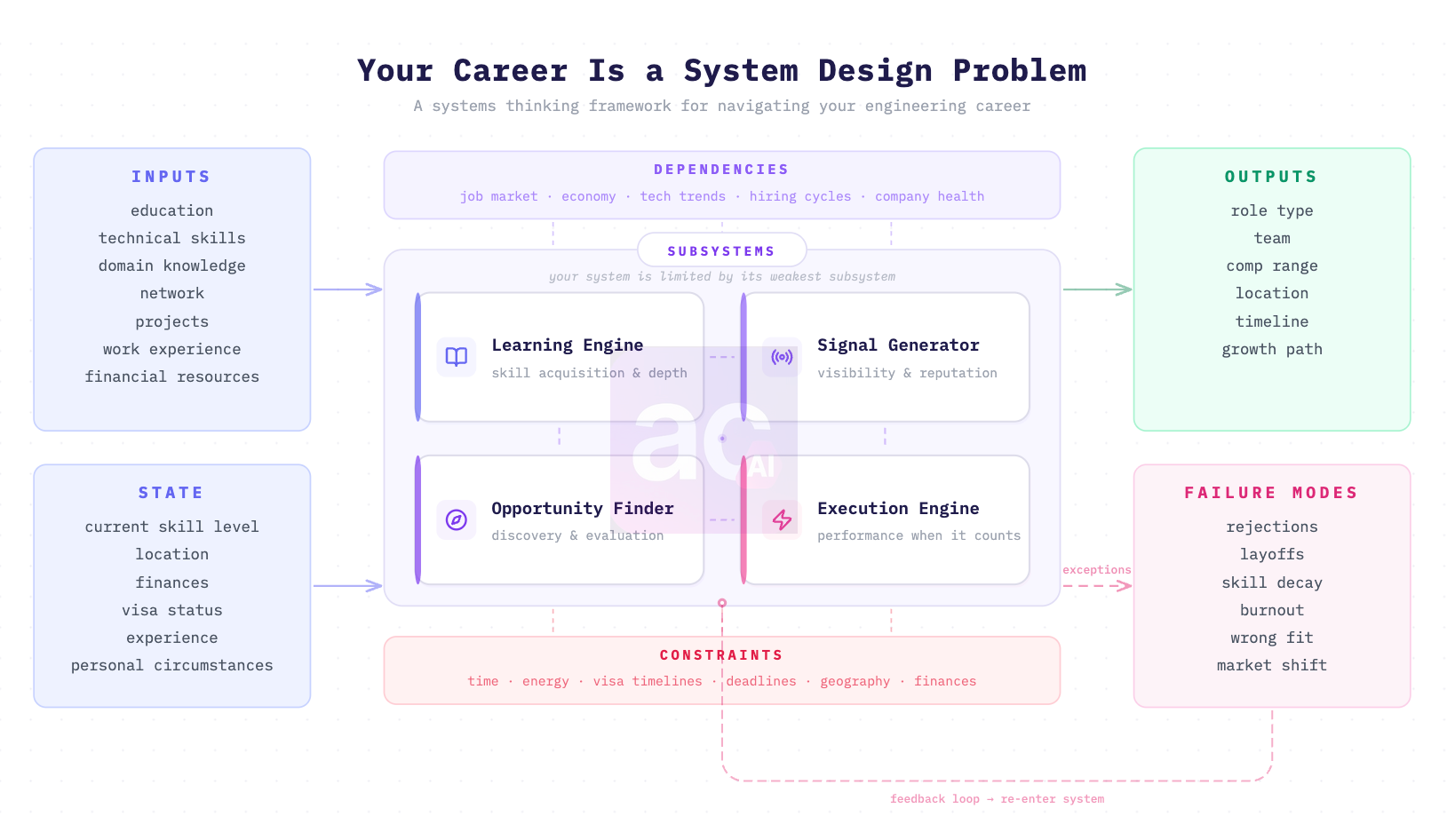
Inputs
Every system needs raw materials. Yours are: education, technical skills, domain knowledge, network, projects, work experience, and financial resources.
These are what you bring to the system — the assets you can deploy, combine, and grow. Your CS degree is an input. Your co-op experience is an input. Your GitHub contributions, your research experience, the alumni network from your university, the savings that give you a few months of runway — all inputs.
Most new engineers undercount their inputs (they forget soft skills, cross-domain knowledge, or relationships that could open doors) or overcount them (they list skills they’ve touched once in a tutorial as if they’re battle-tested). A clear inventory changes your strategy. Someone with strong technical inputs but a thin network needs a different design than someone with a wide network but shallow technical depth.
Write down your actual inputs. Be specific — “I know Python” is vague; “I’ve built two Flask APIs and deployed them on AWS” is an input you can point to. Honesty here prevents you from designing a plan around assets you don’t actually have, and it often reveals strengths you’ve been undervaluing.
State
Current state determines what transitions are possible. A server at 90% memory has different options than one at 30%. Your career works the same way.
Your state includes skills, location, finances, visa status, experience, academic background, and personal circumstances. State is a starting point. Nothing more, nothing less.
This is why generic advice can feel useless. “Just contribute to open source” is solid for someone with free evenings and strong fundamentals. Less helpful if you’re supporting family, still building confidence with data structures, and living in a timezone where active communities are asleep.
The system design instinct: always design from current state. Acknowledge where you are. Then ask the productive question: from here, what are the feasible next moves? Just the next transition.
Dependencies
The job market, the economy, technology trends, hiring freezes, your manager’s priorities — all external systems that shape your career whether you account for them or not.
You can’t eliminate dependencies. You can acknowledge them. If your entire plan depends on one company hiring for one role in one city, that’s a single point of failure. What’s the fallback? For every dependency you can’t control: How likely is it to change? and What’s my approach if it does?
Constraints
Time, energy, geography, visa timelines, graduation deadlines, financial obligations, family responsibilities, health. These are your design parameters — the boundaries that determine which strategies are feasible and which aren’t.
Time is usually the tightest. How many hours per week can you realistically dedicate to career development alongside classes, work, or life? And time has hard edges beyond the weekly — a visa timeline that runs out in 8 months, a graduation date that’s fixed, a lease that ends in June. These deadlines constrain your design in ways that “I should start applying soon” doesn’t capture.
Energy is the constraint people underestimate most. You have a finite amount each day, and different activities draw from different reserves. Grinding LeetCode for three hours after a full day of classes drains a different tank than writing a blog post or having a conversation with a mentor. Designing around your energy patterns — knowing when you’re sharp, when you’re depleted, and what recharges you — is the difference between a sustainable system and one that burns out.
Knowing you can only spend 8 hours a week on career development tells you that 20-hour strategies won’t work right now. That’s clarity. It eliminates approaches that would have failed anyway and focuses you on what can actually work within your reality. The engineers who design the most elegant systems are the ones who understand their constraints deeply and design within them.
Outputs
“A good job” is a wish, not a spec. It’s like telling an engineer “build something nice.”
A useful output definition: “Backend engineer on a team of 10-30 working on data infrastructure at a growth-stage company, earning $X+, in a city I can afford, within 6 months, where I’d work closely with senior engineers.”
Now you have something to design toward. Something to evaluate opportunities against. Something that tells you whether you’re making progress or spinning.
Failure Modes
Rejections happen. Layoffs happen. Specializations lose demand. Burnout hits. You accept an offer and realize in three months it’s wrong.
These are normal operating conditions for a career that spans decades.
Designing for failure means building transferable skills, maintaining relationships beyond your current team, keeping your signal visible even when things are going well, and knowing when to stop a strategy that isn’t working.
Setbacks become information, not verdicts. A rejected application is data about what a specific part of the system needs. That reframe changes how you experience the entire job search.
The Subsystems
The system primitives define the boundaries. The subsystems are where the actual work happens — the four engines that take your inputs and, within your constraints, produce your outputs.
Your overall system is limited by its weakest subsystem.
Identify which subsystem is your bottleneck right now. Then use the five diagnostic questions below it to figure out exactly where it’s breaking. Focus there. Everything else can wait.
📚 Learning Engine
How you acquire and deepen skills. What you’re studying, how you’re studying it, and how you know it’s working.
This is the subsystem most new engineers over-invest in — because learning feels productive and it’s the most familiar mode from university. The real question is whether you’re learning the right things at the right time for your current state and target output. Core skills like system design, distributed systems, and software architecture remain foundational — they’re what let you reason about complex problems. But the landscape now also demands fluency in AI: understanding how LLMs work, how to build with agents and tool-calling patterns, how to evaluate and prompt models effectively, and how to integrate AI into real workflows. The engineers who treat AI as a tool they use passively will fall behind those who understand it deeply enough to build with it.
Diagnose yours:
What are the 3 specific skills most frequently listed in job descriptions matching your target role? Look at 10 real postings. Extract patterns. Go specific — “building REST APIs with FastAPI,” “Collaborating with design, product management, data science, and engineering partners”, “building AI agents with tool-calling,” or “fine-tuning and evaluating LLMs” — the level of specificity that tells you exactly what to practice.
For each skill — can you explain it, do it with reference, or do it under pressure? Interviews require level three. Most prep stops at two. Where are you honestly?
What are you currently learning that does NOT appear in those job descriptions? Not everything needs to be strategic. But if time is scarce, knowing the difference between strategic and recreational learning matters.
How are you validating learning versus just consuming? Watching tutorials feels productive. Building something that works — or breaks in instructive ways — is where learning actually happens.
What’s one skill you’re avoiding because it’s uncomfortable, that you know matters? System design? Understanding how LLMs and agents actually work under the hood? Communication? Writing? The avoided skill is often the real bottleneck.
📡 Signal Generator
How the outside world discovers you. Resume, LinkedIn, GitHub, content you create, reputation among people who’ve worked with you. This is how opportunities find you rather than you chasing every one of them.
This is the subsystem most new engineers under-invest in. You can be the most skilled person in your cohort, and it won’t matter if nobody knows. Signal generation is what converts private capability into public opportunity.
Diagnose yours:
If a hiring manager Googled your name, what would they find? Do this right now. Check LinkedIn, GitHub, anything you’ve published. What narrative does it create?
In the last 30 days, what have you shared that demonstrates your thinking, not just your code? A blog post, a GitHub project, a thoughtful comment in a technical community. Code is commodity. Thinking about code is signal.
Can three people outside your immediate circle describe what you’re good at and what you’re looking for? If not, your signal isn’t propagating. Your network needs to know your state and target to route opportunities your way.
What’s one project or insight you’re sitting on that could become public this week? Lower the bar. A well-written README. A short post about a problem you solved. A comparison of two tools. A signal, not a masterpiece.
Is the signal you’re building genuinely yours — or does it look like everyone else’s? If your portfolio is identical to every other grad using the same AI tools and tutorials, it’s noise. Your unique combination of experiences and interests is what differentiates.
🔍 Opportunity Finder
How you discover and evaluate potential roles. Where you look, how you filter, how you decide what’s worth pursuing.
Most new engineers treat this subsystem as a volume game — apply to as many places as possible and hope something sticks. That’s a brute-force search through an enormous state space. A better approach: constrain the search, increase the signal quality, and shorten the feedback loops.
Diagnose yours:
Can you describe your target role in one specific sentence? Something like: “Backend engineer, team of 10-30, data infrastructure, growth-stage, US, $X+, close to senior engineers.” If you can’t be this specific, your filter is too loose and you’re spending energy on applications that will never convert.
Of your last 10 applications, how many came from a warm introduction? Warm intros convert at dramatically higher rates. If the answer is zero, the problem is strategy, not volume.
What are your 3 non-negotiables and 3 genuine flexibles? Non-negotiable: location, minimum comp, team culture. Flexible: industry, specific tech stack, company stage. Without this clarity, every opportunity feels equally uncertain.
Who are 5 people you could reach out to this month — not for a job, but to learn what their work is actually like? Start with your alumni network and professors — they're already invested in your success and the easiest warm connections you have. Informational conversations are the highest-signal, lowest-pressure path to refining your target and unlocking introductions to people further in.
Are you tracking applications and spotting patterns, or applying and forgetting? A spreadsheet, a Notion board, anything. Which apps got responses? Which didn’t? What patterns emerge? Without this data, you can’t iterate. (Hint: Use Claude Code or GitHub Copilot to build a solution that does this tracking for you and then add it as a personal GitHub project to demonstrate your AI skills)
⚡ Execution Engine
How you perform when it counts. Interviews, communication, negotiation, and the first months on a job.
Strong execution turns a good opportunity into a career-defining one. Weak execution wastes opportunities your other subsystems worked hard to create. This subsystem is where preparation meets pressure — and the gap is usually communication, not knowledge.
Diagnose yours:
From your last 3 interviews, what specific feedback did you receive — and what changed as a result? If you can’t answer, the feedback loop is broken. Either you’re not getting specifics or not incorporating them.
Can you walk through a technical problem out loud — reasoning, trade-offs, decision points — not just arrive at the answer? Practice thinking out loud with a timer running. The skill is narrating your thought process under pressure.
Do you have a 2-minute story for “tell me about yourself” that connects where you are to where you’re heading? A narrative that explains why this role makes sense for your trajectory. Practiced enough to feel natural, specific enough to be memorable.
If you get an offer, do you know what’s negotiable and what your walkaway number is? Comp, Visa sponsorship, start date, team placement, dev budget, signing bonus — all potentially on the table. Know your minimum before you’re in the conversation.
What’s your 90-day plan for day one? Execution doesn’t end at the offer. The first 90 days shape how your new team sees you. Even a rough plan puts you ahead.
Failure Modes
Every well-designed system accounts for how it breaks. Your career system will encounter failures — the question is whether you’ve designed around them or whether they catch you off guard.
Here are the failure modes worth planning for:
Rejections. The most common and the most personal-feeling. In a market where entry-level hiring has dropped 50%, rejections are a statistical reality for nearly everyone. A single rejection tells you almost nothing. A pattern of rejections — same stage, same type of role, same feedback — tells you exactly which subsystem needs work. Track them like you’d track error logs.
Layoffs. Companies restructure. Funding dries up. Entire teams get cut. If your identity, your network, and your signal are all tied to one employer, a layoff doesn’t just end your job — it takes your entire system offline. The mitigation: maintain relationships, visibility, and skills that exist independently of your current role.
Skill decay. The framework you mastered in university loses market relevance. The language you specialized in gets replaced by a new paradigm. AI reshapes what “junior work” means every year. Your learning engine needs to run continuously — and it needs to be pointed at where the market is going, not just where it was when you graduated.
Visa and timeline pressure. For international students, this is one of the hardest constraints. A STEM-OPT clock ticking down, an H-1B lottery with single-digit odds, a work authorization window that narrows with every month of job searching. These are hard deadlines that constrain your entire design space. If this is your situation, your opportunity finder and execution engine need to be optimized for conversion speed, and your fallback plan — whether that’s a different visa pathway, a different geography, or further education — needs to be designed before the clock runs out.
Market uncertainty. Hiring freezes. Recessions. Entire sectors contracting while others expand. You can’t predict these, but you can build a system that’s resilient to them — by maintaining optionality across industries, keeping your skills transferable, and ensuring your signal generator works across domains rather than being locked to one niche.
Wrong fit. You land the role. Three months in, you realize the team culture, the work, or the growth path isn’t what you expected. This often traces back to an unexamined contract — you assumed the role included things that were never explicitly agreed to. The mitigation is in your opportunity finder: those informational conversations before you apply, the specific output definition that gives you criteria to evaluate against, and the non-negotiables list that keeps you from accepting the first offer out of relief.
(Special Mention) Burnout. The failure mode nobody plans for until it hits. Grinding LeetCode after a full day of classes. Applying to hundreds of roles with no system for evaluating what’s working. Saying yes to every networking event, every side project, every “opportunity.” This is where your constraints analysis matters most — designing a sustainable system that respects your energy patterns rather than one that treats you as an infinite resource.
The reframe that makes all of this manageable: setbacks become information, not verdicts. A rejected application is data about what a specific subsystem needs. A layoff is a stress test that reveals which parts of your system were dependent on a single employer. A wrong-fit role is feedback on your output specification. When you see failures as system diagnostics rather than personal judgments, they become inputs to the next iteration rather than reasons to stop iterating.
Optimization Patterns
System defined. Subsystems diagnosed. Failure modes designed for. Now here's what determines how fast the whole thing improves.
Find the bottleneck, then go disproportionate. One subsystem is generally the limiting factor. Spreading effort evenly is like optimizing code that isn’t on the critical path. Find the constraint. Overinvest there. Everything else can wait.
Explore early, exploit with signal. You don’t have enough data yet to know what you should optimize for. That’s expected. Try different types of work, different team sizes, different domains. As you gather signal about what you’re good at and what energizes you, gradually go deeper. The mistake is locking in too early — or never locking in at all.
Ship, learn, adjust. Faster feedback loops mean faster convergence. Put something out — a post, a project, a question in a community — get feedback, course-correct. The people who reach good outcomes fastest are the fastest iterators.
Keep the surface area active. Sometimes a strong skill, a well-timed connection, and a piece of content you shared intersect to create an opportunity none of them could have produced alone. You can’t schedule these moments. But you can create the conditions by keeping multiple subsystems healthy and alive. The most interesting opportunities go to the people with the most active surface area.
Trust the plateau. Careers sit flat for long stretches, then shift rapidly. A breakthrough opportunity. A role that changes your trajectory. The work during the flat stretch is what determines whether the shift goes up or down. The hardest part is staying disciplined when it feels like nothing is moving. Something is. You just can’t see it yet.
Build for recovery, not just performance. The failure modes above will happen — the question is how quickly your system recovers. A rejection should trigger a diagnostic, not a shutdown. A layoff should activate your signal generator and opportunity finder, not leave you starting from scratch. The engineers with the most resilient careers are the ones who maintained multiple subsystems even when everything was going well, so when something breaks, the rest of the system keeps running.
The AI Scale
Everything above gives you the framework — the thinking discipline that turns scattered effort into intentional design. AI is what lets you run that framework at a speed no previous generation of engineers had access to.
Here’s the reality: you are graduating into the first era where a student with a laptop and an AI subscription has access to a personal tutor, a writing editor, a code reviewer, a mock interviewer, a career strategist, and a research assistant — available 24/7, infinitely patient, and getting better every month. Previous generations would have paid thousands for access to what you can get for the price of a coffee subscription.
There is genuinely no excuse for not learning faster, building faster, and iterating faster than any cohort before you.
The engineers who will struggle are the ones spending energy worrying about AI taking their jobs instead of using AI to become the kind of engineer who’s irreplaceable. AI doesn’t replace engineers who can think in systems, design architectures, evaluate trade-offs, and make judgment calls. It replaces the tasks that used to fill junior engineers’ days — and frees you to operate at a higher level earlier. That’s a threat if you defined your value by those tasks. It’s an enormous advantage if you defined your value by your thinking.
Use AI as your core tool. Use it daily. Use it for everything in this framework. But the sequence matters: framework first, AI second. AI without structured thinking is just moving faster in a random direction. With the system design you’ve built above, AI becomes the engine that runs it at scale.
Mapping takes hours, not weeks. Feed your resume and three aspirational job descriptions into Claude or ChatGPT. Ask for gap analysis. Research compensation benchmarks and emerging skill trends in an evening. When mapping takes less effort, you do it more often. When you do it more often, your model stays accurate. Accuracy compounds.
Feedback loops collapse. Want to test whether you explain distributed systems clearly? Write an explanation (or role play with AI), have AI critique it against interview rubrics — before you sit in front of a human. Want to stress-test your resume? Get feedback from a recruiter lens, a hiring manager lens, and a technical reviewer lens in twenty minutes. 3x more feedback cycles in the same calendar time, each building on the corrected output of the last. Over a year, that’s exponential.
AI increases your rate of learning, which improves each iteration, to increases your rate of learning further. That compound curve separates people who use AI with a system from people who use it randomly.
Signal generation goes from hard to automatic. A blog post used to be a multi-day commitment. Now you can draft, iterate, and polish in a fraction of the time. Your signal generator stays active, which expands the surface area for those non-linear opportunities.
But AI creates two failure modes worth designing around.
The first is the illusion of competence. AI can help you produce impressive-looking projects, posts, and interview answers that you don’t deeply understand. It works until someone asks a follow-up, or you need to debug under pressure. The discipline: if AI helped you build it, make sure you can explain the core without AI. If you can’t, you’ve built a dependency with no fallback.
The second is convergence on generic. When every grad uses the same tools to write the same resume and build the same portfolio, everyone looks identical. Your unique state — your specific combination of experiences, interests, and the problems you care about — is something AI can amplify but can’t create from scratch. Use AI to express your thinking more clearly and more often. To amplify what makes you distinctive, not to blend in.
Ship It
Think about where Priya was — and where you might be right now. Doing all the right things. Exhausted. Wondering why it’s not converting. The answer is almost always the same: the effort is real, the system design is missing.
This week, four moves:
Map your state. Skills, constraints, dependencies. Just an accurate picture of where you are.
Pick your bottleneck. Learning engine, signal generator, opportunity finder, or execution engine. One of these is limiting the whole system. Which one?
Answer the five questions for that subsystem. Write them down. Be specific. Writing forces the clarity that thinking alone won’t.
Ship one thing. A blog post, a contribution, a conversation. Something that creates a feedback loop you can learn from.
Each cycle builds on the last. Each one comes faster than the one before. Your career is already running as a system — the inputs are flowing, the dependencies are in play, the clock is ticking on your constraints.
You’re either designing it, or it’s designing itself.
You already know which approach builds better systems.
I wrote this for ambitous students like Priya who are navigating the same challenge in today’s uncertain environment. If this framework changed how you think about your next move, send it to someone in your cohort who’s in the middle of it. The best systems improve more than one node at a time!
-Nikhil Sachdeva
Sources
SignalFire State of Tech Talent Report 2025 — New grad hiring data, Magnificent Seven trends
Stack Overflow: AI vs Gen Z — CS graduate unemployment rates, Federal Reserve labor data
IEEE Spectrum: How to Stay Ahead of AI as an Early-Career Engineer — NACE Job Outlook 2026, employer sentiment
Harvard / FinalRound AI: AI Is Making It Harder for Junior Developers — AI-adopting companies and junior hiring freeze
Rest of World: AI Is Wiping Out Entry-Level Tech Jobs — Global impact on engineering graduates
CIO: Demand for Junior Developers Softens — Industry perspectives on the shift
CodeConductor: Junior Developers in the Age of AI — Nadella, Pichai quotes, GitHub study, LeadDev survey